# MasterHttpRelayVPN-RUST Rust port of [@masterking32's MasterHttpRelayVPN](https://github.com/masterking32/MasterHttpRelayVPN). **All credit for the original idea and the Python implementation goes to [@masterking32](https://github.com/masterking32).** This is a faithful reimplementation of the `apps_script` mode, packaged as two tiny binaries (CLI + desktop UI) with no runtime dependencies. Free DPI bypass via Google Apps Script as a remote relay, with TLS SNI concealment. Your ISP's censor sees traffic going to `www.google.com`; behind the scenes a free Google Apps Script that you deploy in your own Google account fetches the real website for you. **[English Guide](#setup-guide)** | **[راهنمای فارسی](#راهنمای-فارسی)** ## Why this exists The original Python project is excellent but requires Python + `pip install cryptography h2` + system deps. For users in hostile networks that install process is often itself broken (blocked PyPI, missing wheels, Windows without Python). This port is a single ~2.5 MB executable that you download and run. Nothing else. ## How it works ``` Browser / Telegram / xray | | HTTP proxy (8085) or SOCKS5 (8086) v mhrv-rs (local) | | TLS to Google IP, SNI = www.google.com v ^ DPI sees www.google.com | | | Host: script.google.com (inside TLS) v | Google edge frontend ---------+ | v Apps Script relay (your free Google account) | v Real destination ``` The censor's DPI sees `www.google.com` in the TLS SNI and lets it through. Google's frontend hosts both `www.google.com` and `script.google.com` on the same IP and routes by the HTTP `Host` header inside the encrypted stream. For a handful of Google-owned domains (`google.com`, `youtube.com`, `fonts.googleapis.com`, …) the same tunnel is used directly instead of going through the Apps Script relay. This bypasses the per-fetch quota and fixes the "User-Agent is always `Google-Apps-Script`" problem for those domains. You can add more domains via the `hosts` map in config. ## Platforms Linux (x86_64, aarch64), macOS (x86_64, aarch64), Windows (x86_64). Prebuilt binaries on the [releases page](https://github.com/therealaleph/MasterHttpRelayVPN-RUST/releases). ## What's in a release Each archive contains two binaries and a launcher script: | file | purpose | |---|---| | `mhrv-rs` / `mhrv-rs.exe` | CLI. Headless use, servers, automation. Works on all platforms; no system deps on macOS/Windows. | | `mhrv-rs-ui` / `mhrv-rs-ui.exe` | Desktop UI (egui). Config form, Start/Stop/Test buttons, live stats, log panel. | | `run.sh` / `run.command` / `run.bat` | Platform launcher: installs the MITM CA (needs sudo/admin) and then starts the UI. Use this on first run. | macOS archives also ship `mhrv-rs.app` (in `*-app.zip`) — double-click to launch the UI without a terminal. You'll still need to run the CLI (`mhrv-rs --install-cert`) or `run.command` once to install the CA.

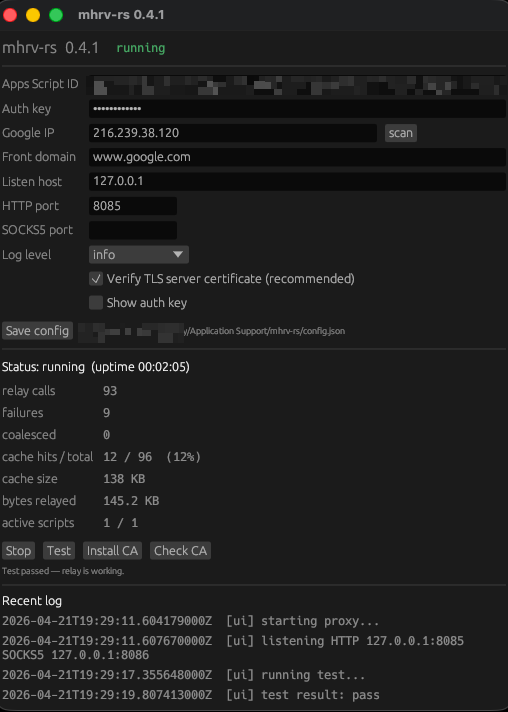
mhrv-rs desktop UI showing config form, live traffic stats, Start/Stop/Test buttons, and log panel

Linux UI also needs common desktop libraries available: `libxkbcommon`, `libwayland-client`, `libxcb`, `libgl`, `libx11`, `libgtk-3`. On most desktop distros these are already present; on a headless box install them via your package manager, or just use the CLI. ## Where things live Config and the MITM CA live in the OS user-data dir: - macOS: `~/Library/Application Support/mhrv-rs/` - Linux: `~/.config/mhrv-rs/` - Windows: `%APPDATA%\mhrv-rs\` Inside that dir: - `config.json` — your settings (written by the UI's **Save** button or hand-edited) - `ca/ca.crt`, `ca/ca.key` — the MITM root certificate. Only you have the private key. The CLI also falls back to `./config.json` in the current directory for backward compatibility with older setups. ## Setup Guide ### Step 1 — Deploy the Apps Script relay (one-time) This part is unchanged from the original project. Follow @masterking32's guide or the summary below: 1. Open while signed into your Google account. 2. **New project**, delete the default code. 3. Copy the contents of [`Code.gs` from the original repo](https://github.com/masterking32/MasterHttpRelayVPN/blob/python_testing/Code.gs) ([raw](https://raw.githubusercontent.com/masterking32/MasterHttpRelayVPN/refs/heads/python_testing/Code.gs)) into the editor. 4. Change `const AUTH_KEY = "..."` to a strong secret only you know. 5. **Deploy → New deployment → Web app**. - Execute as: **Me** - Who has access: **Anyone** 6. Copy the **Deployment ID** (the long random string in the URL). ### Step 2 — Download Grab the archive for your platform from the [releases page](https://github.com/therealaleph/MasterHttpRelayVPN-RUST/releases) and extract it. Or build from source: ```bash cargo build --release --features ui # Binaries: target/release/mhrv-rs and target/release/mhrv-rs-ui ``` ### Step 3 — First run: install the MITM CA To route your browser's HTTPS traffic through the Apps Script relay, `mhrv-rs` has to terminate TLS locally on your machine, forward the request through the relay, and re-encrypt the response with a certificate your browser trusts. That requires a small **local** Certificate Authority. **What actually happens on first run:** - A fresh CA keypair (`ca/ca.crt` + `ca/ca.key`) is generated **on your machine**, in your user-data dir. - The public `ca.crt` is added to your system trust store so browsers accept the per-site certificates `mhrv-rs` mints on the fly. This is the step that needs sudo / Administrator. - The private `ca.key` **never leaves your machine**. Nothing uploads it, nothing phones home, and no remote party — including the Apps Script relay — can use it to impersonate sites to you. - You can revoke it at any time by deleting the CA from your OS keychain (macOS: Keychain Access → System → delete `mhrv-rs`) / Windows cert store / `/etc/ca-certificates`, and removing the `ca/` folder. The launcher does all of this for you and then starts the UI: | platform | how | |---|---| | macOS | double-click `run.command` in Finder (or `./run.command` in a terminal) | | Linux | `./run.sh` from a terminal | | Windows | double-click `run.bat` | It will ask for your password (sudo / UAC) **only** to trust the CA. After that the launcher also starts `mhrv-rs-ui`. On later runs you don't need the launcher — the CA is already trusted, so you can open `mhrv-rs.app` / `mhrv-rs-ui.exe` / `mhrv-rs-ui` directly. If you prefer to do the CA step by hand: ```bash # Linux / macOS sudo ./mhrv-rs --install-cert # Windows (Administrator) mhrv-rs.exe --install-cert ``` Firefox keeps its own cert store; the installer also drops the CA into Firefox's NSS database via `certutil` (best-effort). If Firefox still complains, import `ca/ca.crt` manually via Settings → Privacy & Security → Certificates → View Certificates → Authorities → Import. ### Step 4 — Configure in the UI Open the UI and fill in the form: - **Apps Script ID** — the Deployment ID from Step 1. Comma-separate multiple IDs for round-robin rotation across several deployments (higher quota, more throughput). - **Auth key** — the same secret you set in `Code.gs`. - **Google IP** — `216.239.38.120` is a solid default. Use the **scan** button to probe for a faster one from your network. - **Front domain** — keep `www.google.com`. - **HTTP port** / **SOCKS5 port** — defaults `8085` / `8086`. Hit **Save**, then **Start**. Use **Test** any time to send one request end-to-end through the relay and report the result. ### Step 4 (alternative) — CLI only Everything the UI does is also available in the CLI. Copy `config.example.json` to `config.json` (either next to the binary or into the user-data dir shown above), fill it in: ```json { "mode": "apps_script", "google_ip": "216.239.38.120", "front_domain": "www.google.com", "script_id": "PASTE_YOUR_DEPLOYMENT_ID_HERE", "auth_key": "same-secret-as-in-code-gs", "listen_host": "127.0.0.1", "listen_port": 8085, "socks5_port": 8086, "log_level": "info", "verify_ssl": true } ``` Then: ```bash ./mhrv-rs # serve (default) ./mhrv-rs test # one-shot end-to-end probe ./mhrv-rs scan-ips # rank Google frontend IPs by latency ./mhrv-rs --install-cert # reinstall the MITM CA ./mhrv-rs --help ``` `script_id` can also be a JSON array: `["id1", "id2", "id3"]`. ### Step 5 — Point your client at the proxy The tool listens on **two** ports. Use whichever your client supports: **HTTP proxy** (browsers, generic HTTP clients) — `127.0.0.1:8085` - **Firefox** — Settings → Network Settings → **Manual proxy**. HTTP host `127.0.0.1`, port `8085`, tick **Also use this proxy for HTTPS**. - **Chrome / Edge** — use the system proxy settings, or the **Proxy SwitchyOmega** extension. - **macOS system-wide** — System Settings → Network → Wi-Fi → Details → Proxies → enable **Web Proxy (HTTP)** and **Secure Web Proxy (HTTPS)**, both `127.0.0.1:8085`. - **Windows system-wide** — Settings → Network & Internet → Proxy → **Manual proxy setup**, address `127.0.0.1`, port `8085`. **SOCKS5 proxy** (Telegram, xray, app-level clients) — `127.0.0.1:8086`, no auth. - Works for HTTP, HTTPS, **and** non-HTTP protocols (Telegram's MTProto, raw TCP). The server auto-detects each connection: HTTP/HTTPS go through the Apps Script relay, SNI-rewritable domains go through the direct Google-edge tunnel, and anything else falls through to raw TCP. ## Telegram, IMAP, SSH — pair with xray (optional) The Apps Script relay only speaks HTTP request/response, so non-HTTP protocols (Telegram MTProto, IMAP, SSH, arbitrary raw TCP) can't travel through it. Without anything else, those flows hit the direct-TCP fallback — which means they're not actually tunneled, and an ISP that blocks Telegram will still block them. Fix: run a local [xray](https://github.com/XTLS/Xray-core) (or v2ray / sing-box) with a VLESS/Trojan/Shadowsocks outbound that goes to a VPS of your own, and point mhrv-rs at xray's SOCKS5 inbound via the **Upstream SOCKS5** field (or the `upstream_socks5` config key). When set, raw-TCP flows coming through mhrv-rs's SOCKS5 listener get chained into xray → the real tunnel, instead of connecting directly. ``` Telegram ┐ ┌─ Apps Script ── HTTP/HTTPS ├─ SOCKS5 :8086 ─┤ mhrv-rs ├─ SNI rewrite ─── google.com, youtube.com, … Browser ┘ └─ upstream SOCKS5 ─ xray ── VLESS ── your VPS (Telegram, IMAP, SSH, raw TCP) ``` Example config fragment (both UI and JSON): ```json { "upstream_socks5": "127.0.0.1:50529" } ``` HTTP/HTTPS continues to route through the Apps Script relay (no change), and the SNI-rewrite tunnel for `google.com` / `youtube.com` / etc. keeps bypassing both — so YouTube stays as fast as before while Telegram gets a real tunnel. ## Running on OpenWRT (or any musl distro) The `*-linux-musl-*` archives ship a fully static CLI that runs on OpenWRT, Alpine, and any libc-less Linux userland. Put the binary on the router and start it as a service: ```sh # From a machine that can reach your router: scp mhrv-rs root@192.168.1.1:/usr/bin/mhrv-rs scp mhrv-rs.init root@192.168.1.1:/etc/init.d/mhrv-rs scp config.json root@192.168.1.1:/etc/mhrv-rs/config.json # On the router: chmod +x /usr/bin/mhrv-rs /etc/init.d/mhrv-rs /etc/init.d/mhrv-rs enable /etc/init.d/mhrv-rs start logread -e mhrv-rs -f # tail its logs ``` LAN devices then point their HTTP proxy at the router's LAN IP (default port `8085`) or their SOCKS5 at `:8086`. Set `listen_host` to `0.0.0.0` in `/etc/mhrv-rs/config.json` so the router accepts LAN connections instead of localhost-only. Memory footprint is ~15-20 MB resident — fine on anything with ≥128 MB RAM. No UI is shipped for musl (routers are headless). ## Diagnostics - **`mhrv-rs test`** — sends one request through the relay and reports success/latency. Use this first whenever something breaks — it isolates "relay is up" from "client config is wrong". - **`mhrv-rs scan-ips`** — parallel TLS probe of 28 known Google frontend IPs, sorted by latency. Take the winner and put it in `google_ip`. The UI has the same thing behind the **scan** button next to the Google IP field. - **Periodic stats** are logged every 60 s at `info` level (relay calls, cache hit rate, bytes relayed, active vs. blacklisted scripts). The UI shows them live. ## What's implemented vs. not This port focuses on the **`apps_script` mode** — the only one that reliably works against a modern censor in 2026. Implemented: - [x] Local HTTP proxy (CONNECT for HTTPS, plain forwarding for HTTP) - [x] Local SOCKS5 proxy with smart TLS/HTTP/raw-TCP dispatch (Telegram, xray, etc.) - [x] MITM with on-the-fly per-domain cert generation via `rcgen` - [x] CA generation + auto-install on macOS / Linux / Windows - [x] Firefox NSS cert install (best-effort via `certutil`) - [x] Apps Script JSON relay, protocol-compatible with `Code.gs` - [x] Connection pooling (45 s TTL, max 20 idle) - [x] Gzip response decoding - [x] Multi-script round-robin - [x] Auto-blacklist failing scripts on 429 / quota errors (10-minute cooldown) - [x] Response cache (50 MB, FIFO + TTL, `Cache-Control: max-age` aware, heuristics for static assets) - [x] Request coalescing: concurrent identical GETs share one upstream fetch - [x] SNI-rewrite tunnels (direct to Google edge, bypassing the relay) for `google.com`, `youtube.com`, `youtu.be`, `youtube-nocookie.com`, `fonts.googleapis.com`. Extra domains configurable via the `hosts` map. - [x] Automatic redirect handling on the relay (`/exec` → `googleusercontent.com`) - [x] Header filtering (strip connection-specific, brotli) - [x] `test` and `scan-ips` subcommands - [x] Script IDs masked in logs (`prefix…suffix`) so `info` logs don't leak deployment IDs - [x] Desktop UI (egui) — cross-platform, no bundler needed - [x] Optional upstream SOCKS5 chaining for non-HTTP traffic (Telegram MTProto, IMAP, SSH…) so raw-TCP flows can be tunneled through xray / v2ray / sing-box instead of connecting directly. HTTP/HTTPS keeps going through the Apps Script relay. - [x] Connection pool pre-warm on startup (first request skips the TLS handshake to Google edge). - [x] Per-connection SNI rotation across a pool of Google subdomains (`www/mail/drive/docs/calendar.google.com`), so outbound connection counts aren't concentrated on one SNI. - [x] Optional parallel script-ID dispatch (`parallel_relay`): fan out a relay request to N script instances concurrently, return first success, kill p95 latency at the cost of N× quota. - [x] Per-site stats drill-down in the UI (requests, cache hit %, bytes, avg latency per host) for live debugging. - [x] OpenWRT / Alpine / musl builds — static binaries, procd init script included. Intentionally **not** implemented (rationale included so future contributors don't spend cycles on them): - **HTTP/2 multiplexing** — the `h2` crate state machine (stream IDs, flow control, GOAWAY) has too many subtle hang cases; coalescing + 20-connection pool already gets most of the benefit for this workload. - **Request batching (`q:[...]` mode)** — our connection pool + tokio async already parallelizes well; batching adds ~200 lines of state management with unclear incremental gain. - **Range-based parallel download** — edge cases (non-Range servers, chunked mid-stream, content-encoding) are real; YouTube-style video already bypasses Apps Script via SNI-rewrite tunnel. - **Other modes** (`domain_fronting`, `google_fronting`, `custom_domain`) — Cloudflare killed generic domain fronting in 2024; Cloud Run needs a paid plan. Skip unless specifically requested. ## Known limitations These are inherent to the Apps Script + domain-fronting approach, not bugs in this client. The original Python version has the same issues. - **User-Agent is fixed to `Google-Apps-Script`** for anything going through the relay. `UrlFetchApp.fetch()` does not allow overriding it. Consequence: sites that detect bots (e.g., Google search, some CAPTCHA flows) serve degraded / no-JS fallback pages to relayed requests. Workaround: add the affected domain to the `hosts` map so it's routed through the SNI-rewrite tunnel with your real browser's UA instead. `google.com`, `youtube.com`, `fonts.googleapis.com` are already there by default. - **Video playback is slow and quota-limited** for anything that goes through the relay. YouTube HTML loads through the tunnel (fast), but chunks from `googlevideo.com` go through Apps Script. Each Apps Script consumer account has a ~2 M `UrlFetchApp` calls/day quota and a 50 MB body limit per fetch. Fine for text browsing, painful for 1080p. Rotate multiple `script_id`s for more headroom, or use a real VPN for video. - **Brotli is stripped** from forwarded `Accept-Encoding` headers. Apps Script can decompress gzip, but not `br`, and forwarding `br` produces garbled responses. Minor size overhead. - **WebSockets don't work** through the relay — it's single request/response JSON. Sites that upgrade to WS fail (ChatGPT streaming, Discord voice, etc.). - **HSTS-preloaded / hard-pinned sites** will reject the MITM cert. Most sites are fine because the CA is trusted; a handful aren't. - **Google / YouTube 2FA and sensitive logins** may trigger "unrecognized device" warnings because requests originate from Google's Apps Script IPs, not yours. Log in once via the tunnel (`google.com` is in the rewrite list) to avoid this. ## Security posture - The MITM root stays **on your machine only**. The `ca/ca.key` private key is generated locally and never leaves the user-data dir. - `auth_key` between the client and the Apps Script relay is a shared secret you pick. The server-side `Code.gs` rejects requests without a matching key. - Traffic between your machine and Google's edge is standard TLS 1.3. - What Google can see: the destination URL and headers of each request (because Apps Script fetches on your behalf). This is the same trust model as any hosted proxy — if that's not acceptable, use a self-hosted VPN instead. ## License MIT. See [LICENSE](LICENSE). ## Credit Original project: by [@masterking32](https://github.com/masterking32). The idea, the Google Apps Script protocol, the proxy architecture, and the ongoing maintenance are all his. This Rust port exists purely to make client-side distribution easier. ---
## راهنمای فارسی پورت Rust پروژهٔ [MasterHttpRelayVPN](https://github.com/masterking32/MasterHttpRelayVPN) از [@masterking32](https://github.com/masterking32). **تمام اعتبار ایده و پیاده‌سازی اصلی پایتون متعلق به ایشان است.** این نسخه فقط مدل `apps_script` را به‌صورت دو فایل اجرایی کوچک (CLI + رابط گرافیکی) بدون هیچ وابستگی run-time ارائه می‌دهد. عبور رایگان از DPI با استفاده از Google Apps Script به‌عنوان رله، به‌همراه مخفی‌سازی SNI در TLS. سانسور ISP فکر می‌کند ترافیک شما به سمت `www.google.com` می‌رود؛ در پشت صحنه یک Apps Script که خودتان در اکانت گوگل خودتان دیپلوی کرده‌اید سایت اصلی را برای شما واکشی می‌کند. ### چرا این نسخه؟ نسخهٔ اصلی پایتون عالی است، اما نیاز به Python + نصب `cryptography` و `h2` و چند وابستگی سیستمی دارد. برای کاربرانی که PyPI فیلتر است یا Python ندارند این فرآیند خودش یک دردسر است. این پورت فقط یک فایل اجرایی ~۲.۵ مگابایتی است که دانلود می‌کنید و اجرا می‌کنید. تمام. ### نحوهٔ کار مرورگر/تلگرام/xray شما با این ابزار به‌عنوان HTTP proxy یا SOCKS5 proxy صحبت می‌کند. ابزار ترافیک را از طریق TLS به یک IP گوگل می‌فرستد، اما SNI را `www.google.com` می‌گذارد. داخل TLS رمزگذاری‌شده، header به‌نام `Host: script.google.com` رد می‌شود. DPI فقط `www.google.com` را می‌بیند و اجازه عبور می‌دهد. Apps Script سایت مقصد را واکشی می‌کند و پاسخ را به شما بازمی‌گرداند. برای چند دامنهٔ متعلق به خود گوگل (`google.com`، `youtube.com`، `fonts.googleapis.com` و …) از همین تونل مستقیم استفاده می‌شود بدون عبور از Apps Script. این کار هم مشکل سهمیهٔ Apps Script را حل می‌کند و هم مشکل «User-Agent همیشه Google-Apps-Script است» را برای این دامنه‌ها از بین می‌برد. می‌توانید دامنه‌های بیشتری را از طریق `hosts` در config اضافه کنید. ### پلتفرم‌ها لینوکس (x86_64، aarch64)، مک‌اواس (x86_64، aarch64)، ویندوز (x86_64). فایل‌های آماده در [صفحهٔ releases](https://github.com/therealaleph/MasterHttpRelayVPN-RUST/releases). ### محتوای هر release هر آرشیو شامل دو باینری و یک اسکریپت راه‌انداز است: - `mhrv-rs` / `mhrv-rs.exe` — نسخهٔ CLI، برای سرور و استفادهٔ headless. - `mhrv-rs-ui` / `mhrv-rs-ui.exe` — رابط گرافیکی دسکتاپ (egui). فرم تنظیمات، دکمه‌های Start/Stop/Test، آمار زنده، لاگ. - `run.sh` / `run.command` / `run.bat` — اسکریپت راه‌انداز مخصوص هر سیستم‌عامل: اول CA را نصب می‌کند (نیاز به sudo/Administrator) بعد UI را اجرا می‌کند. **بار اول حتماً همین را اجرا کنید.** نسخهٔ مک آرشیو `*-app.zip` هم دارد که داخلش `mhrv-rs.app` است — با دو بار کلیک از Finder اجرا می‌شود. ولی بار اول باید CA را نصب کنید (با `mhrv-rs --install-cert` یا همان `run.command`). ### مسیر فایل‌ها Config و ریشهٔ MITM در پوشهٔ کاربر سیستم‌عامل قرار می‌گیرند: - مک: `~/Library/Application Support/mhrv-rs/` - لینوکس: `~/.config/mhrv-rs/` - ویندوز: `%APPDATA%\mhrv-rs\` داخل این پوشه: `config.json`، `ca/ca.crt` (گواهی عمومی) و `ca/ca.key` (کلید خصوصی — فقط روی سیستم شماست و هرگز جایی ارسال نمی‌شود). ### مراحل راه‌اندازی #### ۱. دیپلوی Apps Script (یک بار) این بخش دقیقاً همان نسخهٔ اصلی است: ۱. به بروید و با اکانت گوگل وارد شوید. ۲. **New project** بزنید و کد پیش‌فرض را پاک کنید. ۳. محتوای [`Code.gs`](https://github.com/masterking32/MasterHttpRelayVPN/blob/python_testing/Code.gs) ([لینک raw](https://raw.githubusercontent.com/masterking32/MasterHttpRelayVPN/refs/heads/python_testing/Code.gs)) را از ریپو اصلی کپی و Paste کنید. ۴. خط `const AUTH_KEY = "..."` را به یک رمز قوی و مختص خودتان تغییر دهید. ۵. **Deploy → New deployment → Web app** - Execute as: **Me** - Who has access: **Anyone** ۶. **Deployment ID** را کپی کنید (رشتهٔ تصادفی طولانی داخل URL). #### ۲. دانلود آرشیو پلتفرم خود را از [صفحهٔ releases](https://github.com/therealaleph/MasterHttpRelayVPN-RUST/releases) بگیرید و extract کنید. #### ۳. اجرای بار اول: نصب گواهی MITM برای اینکه ترافیک HTTPS مرورگر از طریق Apps Script رد شود، `mhrv-rs` باید TLS را **روی سیستم خودتان** باز کند، درخواست را از رله بفرستد، و پاسخ را با یک گواهی که مرورگر شما trust می‌کند دوباره رمزگذاری کند. این کار یک **Certificate Authority محلی** کوچک نیاز دارد. **چه اتفاقی در اجرای بار اول می‌افتد:** - یک keypair تازهٔ CA (`ca/ca.crt` + `ca/ca.key`) **روی سیستم شما** در پوشهٔ user-data ساخته می‌شود. - فایل عمومی `ca.crt` به trust store سیستم اضافه می‌شود تا مرورگر گواهی‌های per-site که `mhrv-rs` on-the-fly می‌سازد را بپذیرد. همین مرحله است که sudo / Administrator می‌خواهد. - کلید خصوصی `ca.key` **هرگز از سیستم شما خارج نمی‌شود**. جایی آپلود نمی‌شود، با هیچ سرور راه دوری تماس گرفته نمی‌شود، و هیچ طرف دیگری — از جمله رلهٔ Apps Script — نمی‌تواند با آن خودش را جای سایت‌ها جا بزند. - هر وقت خواستید می‌توانید حذفش کنید: keychain مک (Keychain Access → System → `mhrv-rs` را حذف کنید) / cert store ویندوز / `/etc/ca-certificates` در لینوکس، به‌علاوهٔ پاک کردن پوشهٔ `ca/`. اسکریپت راه‌انداز همهٔ این کارها را برایتان انجام می‌دهد و بعد UI را باز می‌کند: - **مک**: روی `run.command` دو بار کلیک کنید (یا از ترمینال `./run.command`). - **لینوکس**: در ترمینال `./run.sh`. - **ویندوز**: روی `run.bat` دو بار کلیک کنید. اسکریپت **فقط** برای trust کردن CA رمز شما را می‌خواهد (sudo یا UAC). بعد از آن UI هم باز می‌شود، و در اجراهای بعدی دیگر لازم نیست از launcher استفاده کنید — مستقیماً `mhrv-rs.app` یا `mhrv-rs-ui.exe` یا `mhrv-rs-ui` را اجرا کنید. اگر ترجیح می‌دهید مرحلهٔ CA را دستی انجام دهید: ```bash # لینوکس/مک sudo ./mhrv-rs --install-cert # ویندوز (به‌عنوان Administrator) mhrv-rs.exe --install-cert ``` Firefox cert store خودش را جدا دارد؛ installer تلاش می‌کند از طریق `certutil` گواهی را داخل NSS فایرفاکس هم بیندازد (best-effort). اگر فایرفاکس هنوز شکایت کرد، خودتان دستی `ca/ca.crt` را از Settings → Privacy & Security → Certificates → View Certificates → Authorities → Import اضافه کنید. #### ۴. تنظیمات در UI فرم را پر کنید: - **Apps Script ID** — همان Deployment ID مرحلهٔ ۱. برای استفاده از چند deployment به‌صورت round-robin، با کاما جدا کنید. - **Auth key** — همان رمز `AUTH_KEY` داخل `Code.gs`. - **Google IP** — پیش‌فرض `216.239.38.120` خوب است. دکمهٔ **scan** کنارش IPهای دیگر گوگل را از شبکهٔ شما تست می‌کند و سریع‌ترین را معرفی می‌کند. - **Front domain** — همان `www.google.com` را نگه دارید. - **HTTP port** / **SOCKS5 port** — پیش‌فرض‌ها `8085` و `8086`. **Save** بعد **Start**. دکمهٔ **Test** در هر زمان یک درخواست کامل از طریق رله می‌فرستد و نتیجه را گزارش می‌دهد. #### ۴ (جایگزین). فقط CLI هر کاری که UI می‌کند از CLI هم قابل انجام است. `config.example.json` را به `config.json` کپی و مقادیر را پر کنید، بعد: ```bash ./mhrv-rs # اجرای proxy ./mhrv-rs test # تست یک درخواست کامل ./mhrv-rs scan-ips # رتبه‌بندی IPهای گوگل بر اساس تأخیر ./mhrv-rs --install-cert # نصب مجدد CA ./mhrv-rs --help ``` #### ۵. تنظیم proxy در کلاینت ابزار روی **دو** پورت گوش می‌دهد: **HTTP proxy** (مرورگرها) — `127.0.0.1:8085` - **Firefox** — Settings → Network Settings → **Manual proxy**. HTTP برابر `127.0.0.1`، port `8085`، تیک **Also use this proxy for HTTPS**. - **Chrome / Edge** — از تنظیمات proxy سیستم یا افزونهٔ **Proxy SwitchyOmega** استفاده کنید. - **مک (system-wide)** — System Settings → Network → Wi-Fi → Details → Proxies → **Web Proxy (HTTP)** و **Secure Web Proxy (HTTPS)** را فعال کنید، هر دو `127.0.0.1:8085`. - **ویندوز (system-wide)** — Settings → Network & Internet → Proxy → **Manual proxy setup**، address `127.0.0.1`، port `8085`. **SOCKS5 proxy** (تلگرام، xray، کلاینت‌های app-level) — `127.0.0.1:8086`، بدون auth. برای HTTP و HTTPS و **هم** پروتکل‌های غیر-HTTP (MTProto تلگرام، TCP خام) کار می‌کند. ابزار به‌صورت هوشمند تشخیص می‌دهد: HTTP/HTTPS از رلهٔ Apps Script می‌رود، دامنه‌های قابل SNI-rewrite از تونل مستقیم لبهٔ گوگل، و بقیه به TCP خام می‌افتد. ### تلگرام، IMAP، SSH — با xray جفت کنید (اختیاری) رلهٔ Apps Script فقط HTTP request/response می‌فهمد، پس پروتکل‌های غیر-HTTP (MTProto تلگرام، IMAP، SSH، TCP خام) از داخلش عبور نمی‌کنند. بدون کار اضافه این جور ترافیک به مسیر TCP مستقیم می‌افتد — یعنی واقعاً tunnel نمی‌شود و اگر ISP تلگرام را بلاک کرده باشد، همچنان بلاک است. راه حل: یک [xray](https://github.com/XTLS/Xray-core) (یا v2ray / sing-box) با outbound VLESS/Trojan/Shadowsocks به یک VPS شخصی خودتان بالا بیاورید، و mhrv-rs را از طریق فیلد **Upstream SOCKS5** در UI (یا کلید `upstream_socks5` در config) به SOCKS5 inbound آن وصل کنید. با این کار ترافیک TCP خامی که از SOCKS5 mhrv-rs رد می‌شود، به‌جای اتصال مستقیم، از xray رد شده و به تونل واقعی می‌رسد. ``` تلگرام ┐ ┌─ Apps Script ── HTTP/HTTPS ├─ SOCKS5 :8086 ┤ mhrv-rs ├─ SNI rewrite ─── google.com, youtube.com, … مرورگر ┘ └─ upstream SOCKS5 ─ xray ── VLESS ── VPS شما (تلگرام، IMAP، SSH، TCP خام) ``` قطعه‌ای از config: ```json { "upstream_socks5": "127.0.0.1:50529" } ``` HTTP/HTTPS هیچ تغییری نمی‌کند (همچنان از Apps Script می‌رود) و تونل SNI-rewrite برای `google.com` / `youtube.com` / … هم سر جای خودش است — پس یوتوب مثل قبل سریع می‌ماند و تلگرام بالاخره یک تونل واقعی می‌گیرد. ### اجرا روی OpenWRT (یا هر سیستم musl) آرشیوهای `*-linux-musl-*` یک CLI کاملاً static می‌دهند که روی OpenWRT، Alpine و هر userland لینوکسی بدون glibc اجرا می‌شود. باینری را روی روتر بگذارید و به‌عنوان سرویس راه بیندازید: ```sh # از یک ماشین که به روترتان می‌رسد: scp mhrv-rs root@192.168.1.1:/usr/bin/mhrv-rs scp mhrv-rs.init root@192.168.1.1:/etc/init.d/mhrv-rs scp config.json root@192.168.1.1:/etc/mhrv-rs/config.json # روی خود روتر: chmod +x /usr/bin/mhrv-rs /etc/init.d/mhrv-rs /etc/init.d/mhrv-rs enable /etc/init.d/mhrv-rs start logread -e mhrv-rs -f ``` بعدش دستگاه‌های LAN، proxy HTTP خودشان را روی IP روتر پورت `8085` (یا SOCKS5 روی `8086`) بگذارند. در `/etc/mhrv-rs/config.json` مقدار `listen_host` را به `0.0.0.0` تغییر دهید تا روتر از LAN هم connection بپذیرد (نه فقط localhost). مصرف حافظه حدود ۱۵-۲۰ مگابایت است — روی هر روتری با حداقل ۱۲۸ مگابایت RAM اجرا می‌شود. UI برای musl ساخته نمی‌شود (روترها بدون صفحه‌نمایش هستند). ### محدودیت‌های شناخته‌شده این‌ها محدودیت‌های ذاتی روش Apps Script + SNI هستند، نه باگ در این کلاینت. نسخهٔ اصلی پایتون هم دقیقاً همین‌ها را دارد. - **User-Agent همیشه `Google-Apps-Script` است** برای هر چیزی که از رله رد می‌شود. `UrlFetchApp.fetch()` گوگل اجازهٔ تغییر این را نمی‌دهد. نتیجه: سایت‌هایی که ربات را تشخیص می‌دهند (مثل جست‌وجوی `google.com`، بعضی CAPTCHAها) نسخهٔ سادهٔ بدون JS را نشان می‌دهند. راه‌حل: دامنهٔ موردنظر را به `hosts` در `config.json` اضافه کنید تا از تونل SNI-rewrite (با UA واقعی مرورگر) رد شود. `google.com`، `youtube.com`، `fonts.googleapis.com` از قبل در این لیست هستند. - **پخش ویدیو کند است و سهمیه دارد** برای چیزهایی که از رله رد می‌شوند. HTML یوتوب از تونل می‌آید (سریع)، اما chunkهای ویدیو از `googlevideo.com` از طریق Apps Script می‌آیند. هر اکانت consumer گوگل روزانه ~۲ میلیون `UrlFetchApp` call و سقف ۵۰ مگابایت روی هر fetch دارد. برای مرور متنی عالی است، برای ۱۰۸۰p دردناک. چند `script_id` بگذارید، یا برای ویدیو از VPN واقعی استفاده کنید. - **Brotli فیلتر می‌شود** از header ارسالی `Accept-Encoding`. Apps Script می‌تواند gzip باز کند اما brotli نه، و اگر `br` را رد کنیم پاسخ خراب می‌شود. gzip فعال است. سربار حجمی جزئی. - **WebSocket کار نمی‌کند** از طریق رله (تک request/response JSON است). سایت‌هایی که به WS ارتقا می‌دهند fail می‌کنند (streaming ChatGPT، voice دیسکورد و غیره). - **سایت‌های HSTS-preloaded / pin-شده** گواهی MITM را قبول نمی‌کنند. اکثر سایت‌ها مشکلی ندارند چون CA ما trust شده، ولی چند مورد استثنا هستند. - **ورود دومرحله‌ای گوگل/یوتوب** ممکن است «دستگاه ناشناس» هشدار بدهد چون درخواست از IP Apps Script می‌آید نه IP شما. یک بار با تونل (`google.com` از قبل در لیست است) لاگین کنید. ### امنیت - ریشهٔ MITM **فقط روی سیستم شما می‌ماند**. کلید خصوصی `ca/ca.key` محلی ساخته می‌شود و هرگز از user-data dir خارج نمی‌شود. - `auth_key` بین کلاینت و Apps Script یک secret مشترک است که خودتان انتخاب می‌کنید. کد سرور (`Code.gs`) هر درخواستی را که این کلید را نداشته باشد رد می‌کند. - ترافیک بین سیستم شما و لبهٔ گوگل TLS 1.3 استاندارد است. - آنچه گوگل می‌بیند: URL و headerهای درخواست (چون Apps Script به‌جای شما fetch می‌کند). این دقیقاً همان trust model هر proxy میزبانی‌شده است — اگر قابل قبول نیست از VPN self-hosted استفاده کنید. ### اعتبار پروژهٔ اصلی: توسط [@masterking32](https://github.com/masterking32). ایده، پروتکل Apps Script، معماری proxy و نگهداری همه متعلق به ایشان است. این پورت Rust فقط برای ساده‌کردن توزیع سمت کلاینت درست شده.